CLV-3D Autonomous Enclosure
CLV-3D Autonomous Enclosure
An autonomous low-cost enclosure that integrates cabinetry, directional airflow containment, and a distributed wireless sensor network into a closed-loop environmental control system for self contained resin 3D printing and safe indoor sanding and painting.
An autonomous low-cost enclosure that integrates cabinetry, directional airflow containment, and a distributed wireless sensor network into a closed-loop environmental control system for self contained resin 3D printing and safe indoor sanding and painting.
Project Type
Systems Engineering & Embedded Systems
Systems Engineering & Embedded Systems
Key Skills
Systems Engineering, Parametric CAD Design, Embedded Programming (C++), Ventilation System Design, Custom Fabrication & Integration
Systems Engineering, Parametric CAD Design, Embedded Programming (C++), Ventilation System Design, Custom Fabrication & Integration
Primary Tools
Autodesk Fusion 360, Arduino IDE, Formlabs Form 4 Ecosystem, FDM 3D printing, Unexpected Maker FeatherS2, Adafruit QTPY ESP32-S3, BME680 & PMSA0031 Sensors, Custom Laser-Cut Acrylic
Autodesk Fusion 360, Arduino IDE, Formlabs Form 4 Ecosystem, FDM 3D printing, Unexpected Maker FeatherS2, Adafruit QTPY ESP32-S3, BME680 & PMSA0031 Sensors, Custom Laser-Cut Acrylic
Project Overview
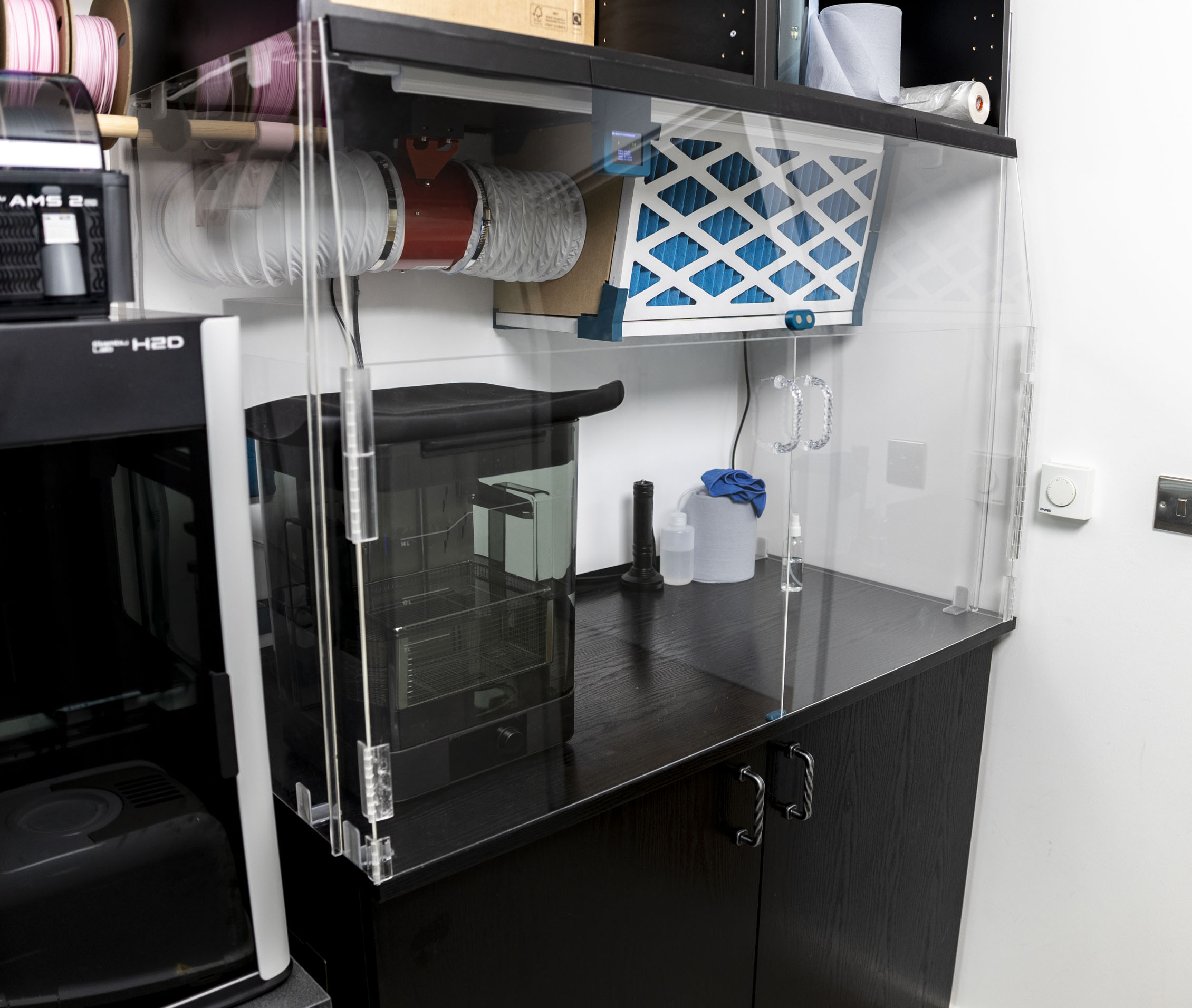
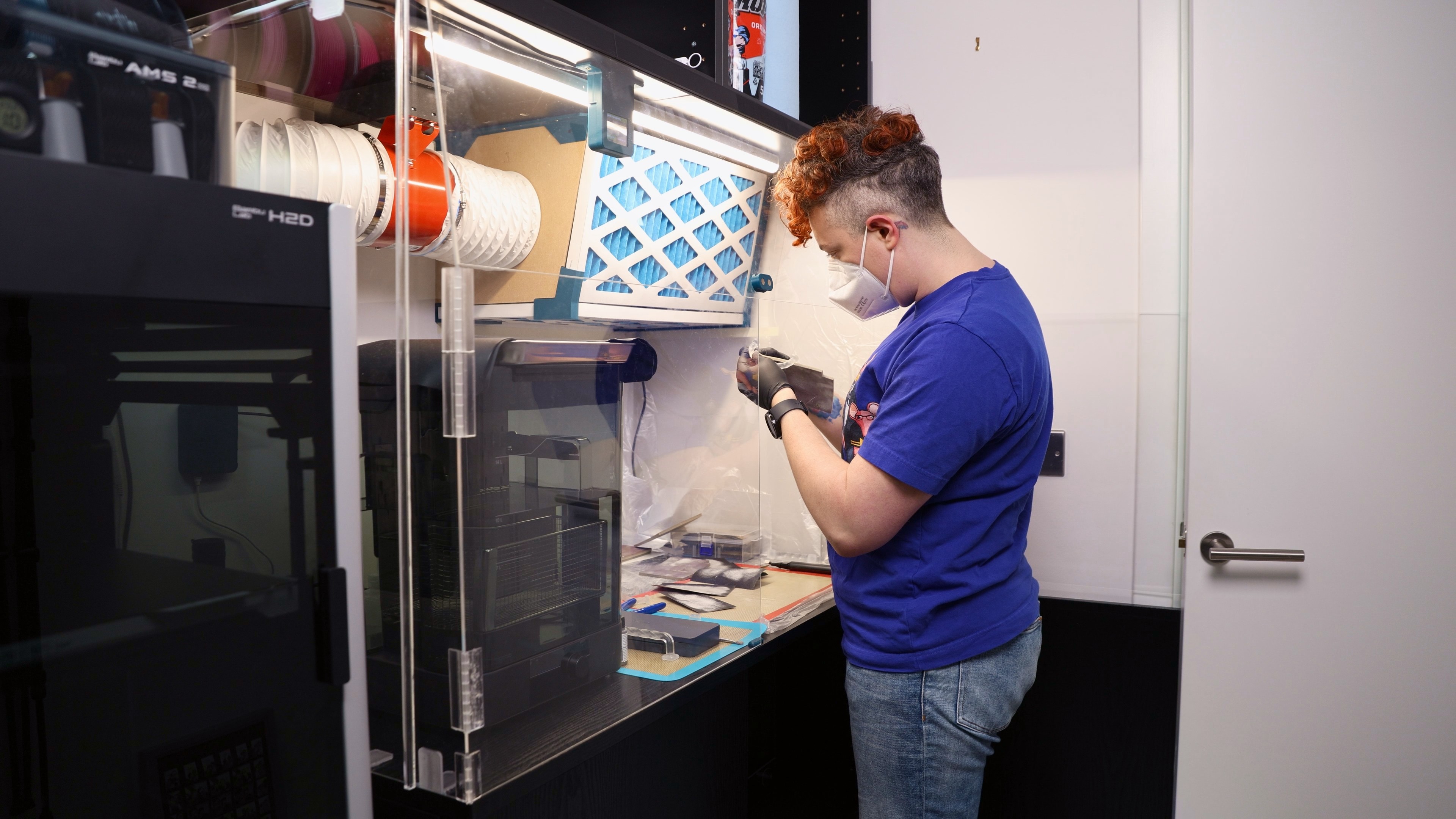
The CLV-3D is a fully integrated, self-regulating environmental control enclosure designed to enable the safe operation of SLA resin printing hardware within highly constrained, unventilated indoor spaces. Operating in an environment where direct external exhaust was impossible, the project required a comprehensive systems approach. The resulting build co-designs structural cabinetry, a dynamic containment ventilation loop, and a distributed wireless sensor network to establish a reliable, automated safety envelope.
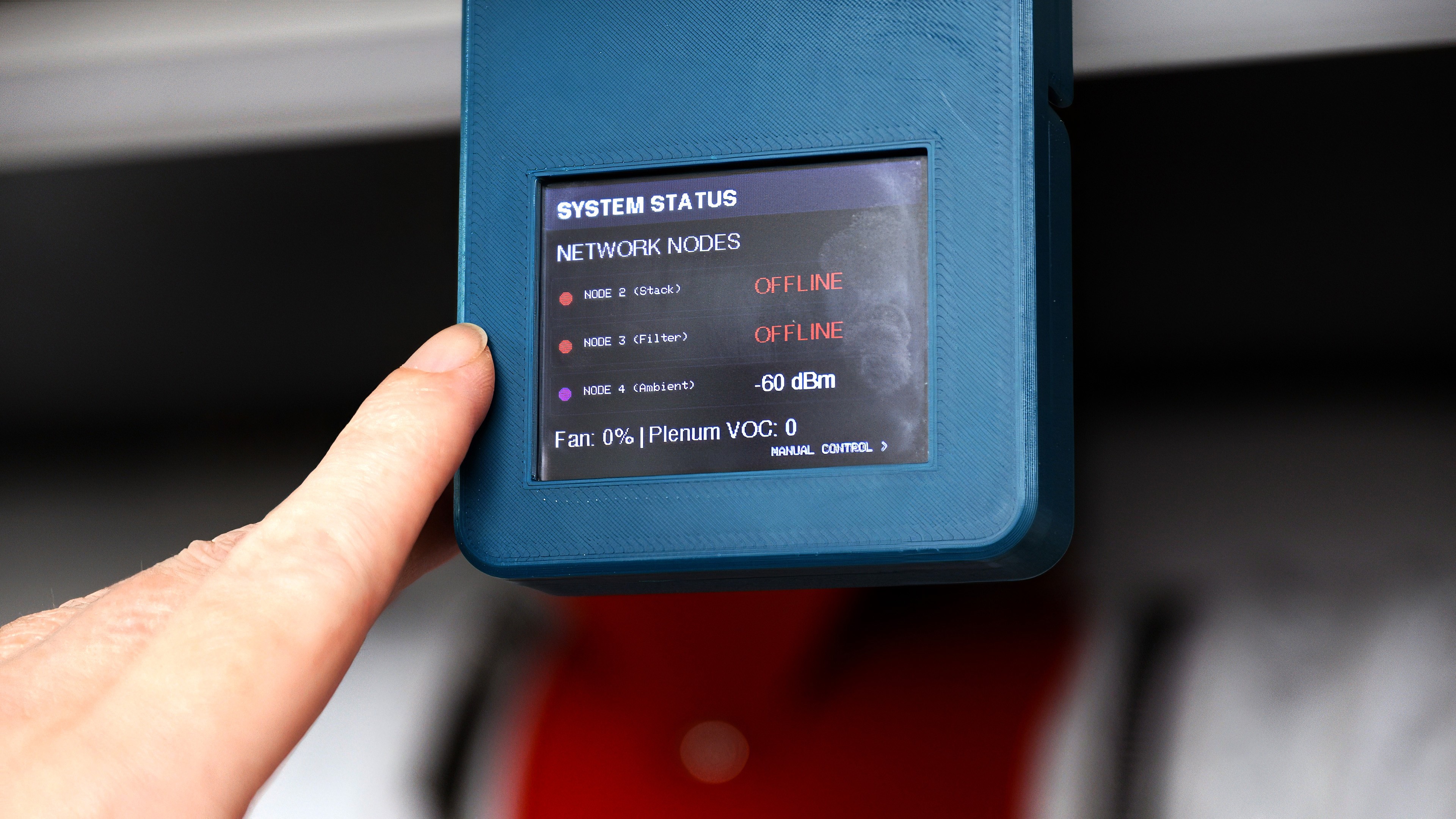
The system is constructed on a modified modular cabinet framework and sealed with custom laser-cut panels to establish a dynamic inward draft. Control logic is distributed across a four-node wireless microcontroller network utilizing the ESP-NOW protocol, monitoring volatile organic compounds (VOCs) and particulate levels in real time. The system automatically adjusts fan speed in response to air quality fluctuations, using a 0–10V analog signal to scale extraction when contamination rises, while a dedicated display node provides a live diagnostics dashboard. Designed for long-term reliability and multi-functional workshop utility, the complete system has been released open source and can be found here.
The CLV-3D is a fully integrated, self-regulating environmental control enclosure designed to enable the safe operation of SLA resin printing hardware within highly constrained, unventilated indoor spaces. Operating in an environment where direct external exhaust was impossible, the project required a comprehensive systems approach. The resulting build co-designs structural cabinetry, a dynamic containment ventilation loop, and a distributed wireless sensor network to establish a reliable, automated safety envelope.
The system is constructed on a modified modular cabinet framework and sealed with custom laser-cut panels to establish a dynamic inward draft. Control logic is distributed across a four-node wireless microcontroller network utilizing the ESP-NOW protocol, monitoring volatile organic compounds (VOCs) and particulate levels in real time. The system automatically adjusts fan speed in response to air quality fluctuations, using a 0–10V analog signal to scale extraction when contamination rises, while a dedicated display node provides a live diagnostics dashboard. Designed for long-term reliability and multi-functional workshop utility, the complete system has been released open source and can be found here.

The Challenges
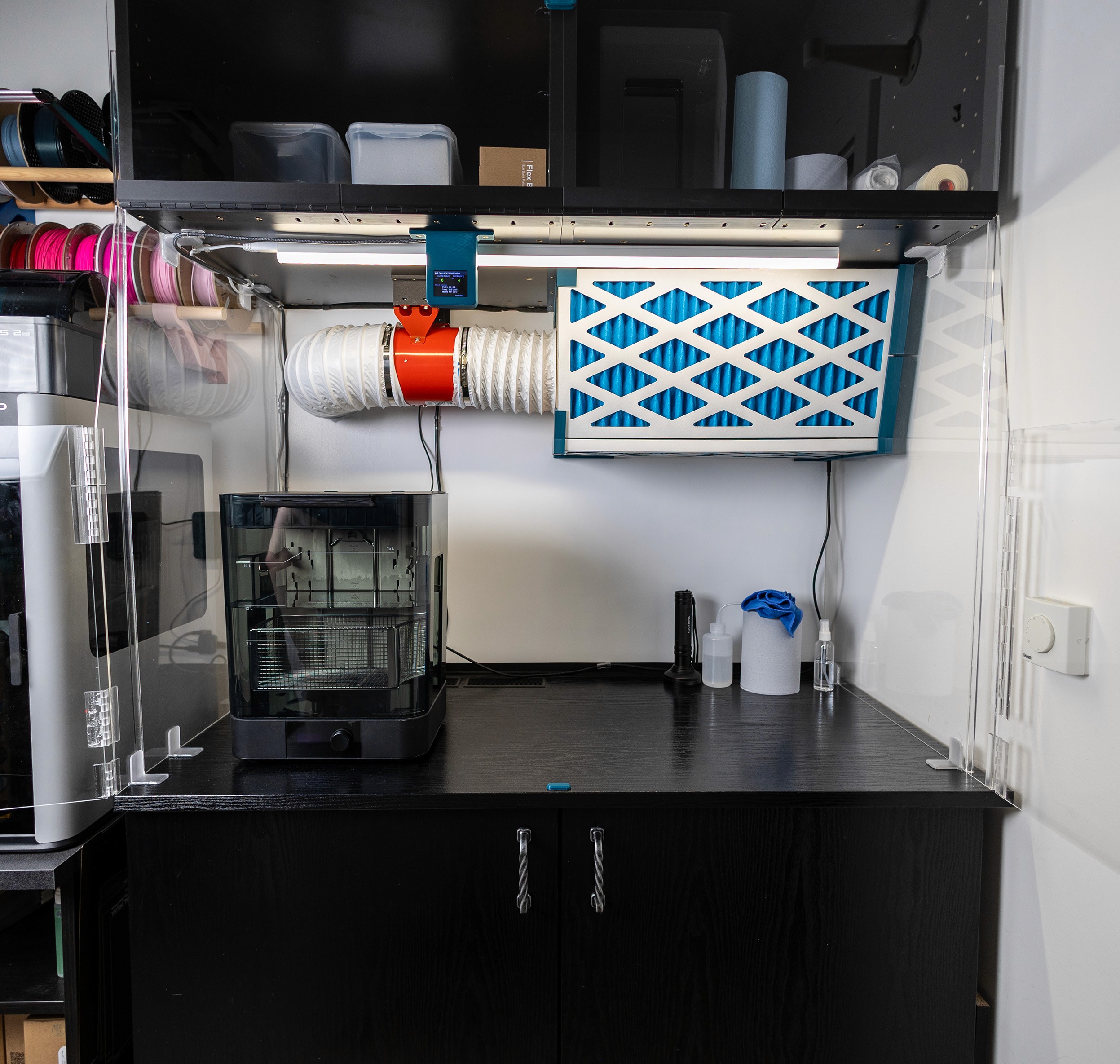
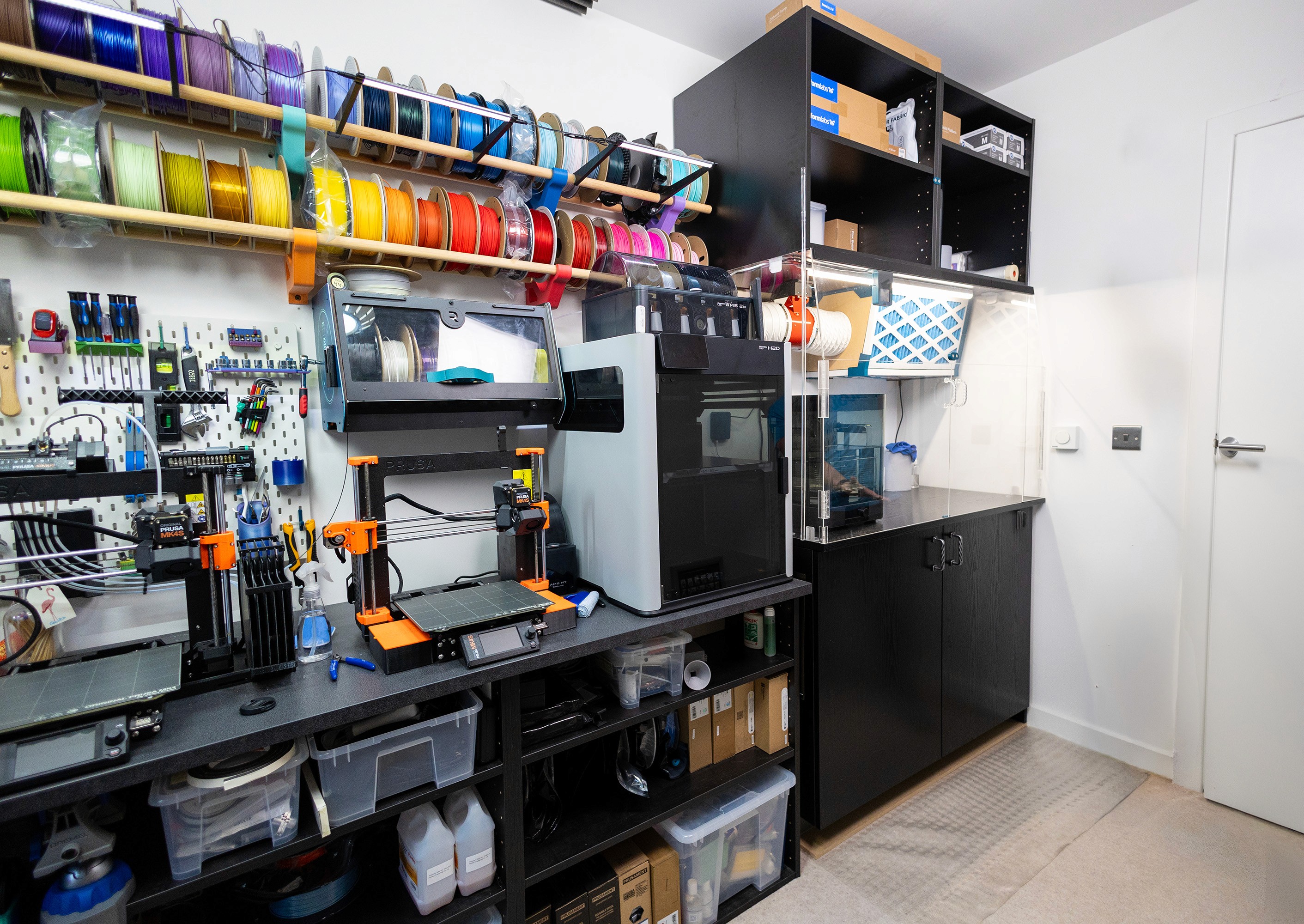
Constraint-Led Systems Integration: Fitting a printer, wash station, cure oven, fan assembly, carbon filter, sensor array, and full consumables storage into the available space (a 120 × 70 × 240 cm alcove) required every subsystem to be precisely mapped before fabrication began. With virtually zero margin for mid-build corrections, every spatial, electrical, and airflow interface had to be co-designed.
Directional Airflow & Fume Containment: Because the workshop has no sealable external windows, filtration had to operate entirely via multi-pass recirculation without venting outside. This required engineering a dynamic containment system; establishing continuous extraction that maintains a consistent inward airflow through any panel gaps, ensuring fumes cannot escape into the workspace.
Distributed Coordination & Sensor Drift Mitigation: Creating a clean, cable-free cabinet interior required distributing sensors across four wireless nodes. However, operating without centralized router infrastructure meant designing a peer-to-peer data pipeline, while the raw nature of VOC sensors meant solving the "normalization trap", where sensors in filtered environments drift and memorize "extra-clean" air as their zero baseline, breaking efficiency calculations.
Constraint-Led Systems Integration: Fitting a printer, wash station, cure oven, fan assembly, carbon filter, sensor array, and full consumables storage into the available space (a 120 × 70 × 240 cm alcove) required every subsystem to be precisely mapped before fabrication began. With virtually zero margin for mid-build corrections, every spatial, electrical, and airflow interface had to be co-designed.
Directional Airflow & Fume Containment: Because the workshop has no sealable external windows, filtration had to operate entirely via multi-pass recirculation without venting outside. This required engineering a dynamic containment system; establishing continuous extraction that maintains a consistent inward airflow through any panel gaps, ensuring fumes cannot escape into the workspace.
Distributed Coordination & Sensor Drift Mitigation: Creating a clean, cable-free cabinet interior required distributing sensors across four wireless nodes. However, operating without centralized router infrastructure meant designing a peer-to-peer data pipeline, while the raw nature of VOC sensors meant solving the "normalization trap", where sensors in filtered environments drift and memorize "extra-clean" air as their zero baseline, breaking efficiency calculations.
Solution and Process
Spatial Planning & Parametric Design: The full alcove was modelled at scale in Fusion 360, validating exact clearances for the Form 4 lid swing, wash station height, and drawer pull-out depth under load. This drove the structural framework, utilizing METOD base and wall cabinets, and a custom three-door front configuration that handles the upper-to-lower cabinet offset while providing the panel coverage needed for spray-painting and sanding use.
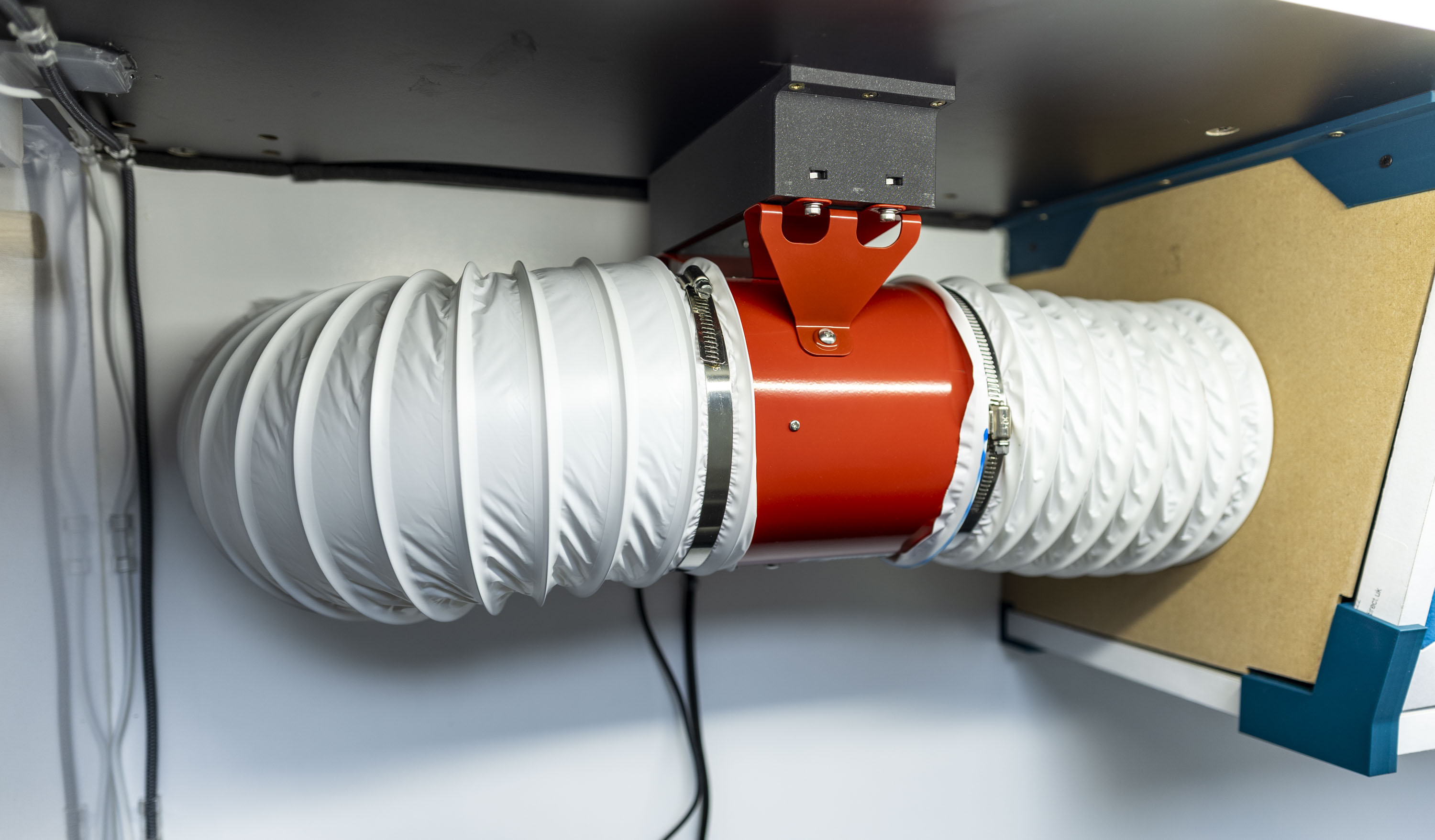
Airflow Engineering & Dynamic Containment: The AC Infinity carbon filter mounts to the underside of the upper unit, functioning as a multi-pass scrubber with G4 panel pre-filters upstream to catch particulates. The inline fan pushes filtered air through a short duct into the space behind the enclosure, creating a rear plenum that guides air downward before it re-enters the cabinet. Continuous fan operation maintains a dynamic inward draft, transforming minor panel gaps into passive intake vents and ensuring fume containment without requiring a complex, airtight seal.
Closed-Loop Automation & Smart Calibration: Fan speed is governed by a hybrid gradient control loop, scaling the Rhino EC fan from a 10% baseline idle up to 100% throughput when VOC or particulate thresholds are breached. G4 pre-filter health is calculated by comparing pressure differentials against a commissioned baseline curve. To prevent sensor drift, a Unified Self-Healing algorithm was implemented: the external node acts as a "True Zero" anchor, gently nudging the internal and plenum sensors' baselines in lock-step to maintain accurate filter efficiency math without triggering false alerts.
Fail-Safe Engineering & Longevity: To transition the project from a prototype to a long-term use item, several reliability safeguards were programmed:
Laser Life Preservation: A three-tier power state machine manages the particulate sensors, running them continuously during active prints/sanding and dropping them to sleep duty cycles when idle to extend laser lifespan from 1.5 years to a decade.
Firmware Hardening: Implemented zero-division shields to prevent calculation crashes and baseline sanity clamps to halt digital runaway.
Flash Wear Protection: Calibration parameters are committed to ESP32 Non-Volatile Storage (NVS) only when changes exceed 1% threshold, protecting memory cells from premature wear.
Spatial Planning & Parametric Design: The full alcove was modelled at scale in Fusion 360, validating exact clearances for the Form 4 lid swing, wash station height, and drawer pull-out depth under load. This drove the structural framework, utilizing METOD base and wall cabinets, and a custom three-door front configuration that handles the upper-to-lower cabinet offset while providing the panel coverage needed for spray-painting and sanding use.
Airflow Engineering & Dynamic Containment: The AC Infinity carbon filter mounts to the underside of the upper unit, functioning as a multi-pass scrubber with G4 panel pre-filters upstream to catch particulates. The inline fan pushes filtered air through a short duct into the space behind the enclosure, creating a rear plenum that guides air downward before it re-enters the cabinet. Continuous fan operation maintains a dynamic inward draft, transforming minor panel gaps into passive intake vents and ensuring fume containment without requiring a complex, airtight seal.
Closed-Loop Automation & Smart Calibration: Fan speed is governed by a hybrid gradient control loop, scaling the Rhino EC fan from a 10% baseline idle up to 100% throughput when VOC or particulate thresholds are breached. G4 pre-filter health is calculated by comparing pressure differentials against a commissioned baseline curve. To prevent sensor drift, a Unified Self-Healing algorithm was implemented: the external node acts as a "True Zero" anchor, gently nudging the internal and plenum sensors' baselines in lock-step to maintain accurate filter efficiency math without triggering false alerts.
Fail-Safe Engineering & Longevity: To transition the project from a prototype to a long-term use item, several reliability safeguards were programmed:
Laser Life Preservation: A three-tier power state machine manages the particulate sensors, running them continuously during active prints/sanding and dropping them to sleep duty cycles when idle to extend laser lifespan from 1.5 years to a decade.
Firmware Hardening: Implemented zero-division shields to prevent calculation crashes and baseline sanity clamps to halt digital runaway.
Flash Wear Protection: Calibration parameters are committed to ESP32 Non-Volatile Storage (NVS) only when changes exceed 1% threshold, protecting memory cells from premature wear.